2020-2021 Lesson 13 of 32


TECHNIQUE

  1. Hanon No. 1

    1. (NEW) RH and LH alone, ascending and descending.

    2. (NEW) Use CLOSE, LEGATO FINGERS to the keyboard.

  2. Major Scales

    1. RH and LH Alone

      1. (NEW TODAY: E Major)

      2. Say the pattern out loud

      3. m.m. 76 per note.

    2. HT (Hands Together)

      1. (NEW TODAY: A Major)

      2. C Major, G Major, D Major

      3. m.m. 60 per note.

        1. RH: when you cross over finger 3, keep your wrist steady.

        2. Tidy attacks.

THEORY: Level 1

  1. Level 2: Unit 1

    1. Hold for now.


MUSICIANSHIP

  1. Four Star Sightreading and Ear Tests: Level 1

    1. PREPARE: Review Set 1

    2. Next: Set 2

      1. SIGHTREADING

        1. SAY OUT LOUD:

          1. WHAT IS MY KEY SIGNATURE?

          2. WHAT ARE THE INTERVALS?


READING

  1. Piano Adventures Sightreading Level 1 - move on from page 84

    1. Once your start, do not stop!

    2. If you mess up, go on!

    3. Beat is most important.

    4. Before you start, look through the entire thing!

    5. SLOW., no faster than m.m. 72 per quarter note.


REPERTOIRE

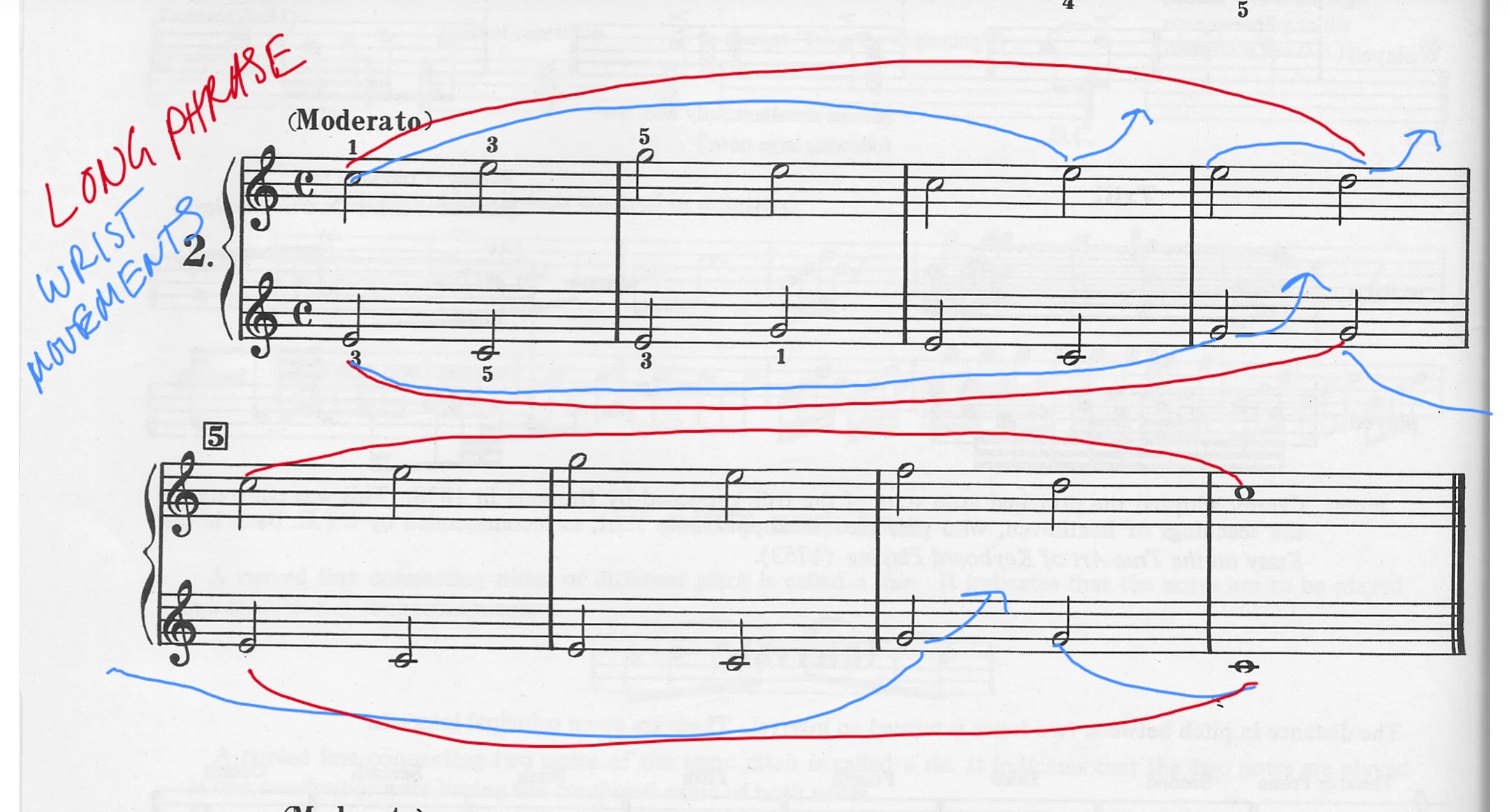
  1. (NEW) Czerny Op. 823 No. 6

    1. Create a “wrist arrow chart.”

    2. Create a NFRPE Chart.

  2. Burgmuller Op. 100 No. 2

    1. One measure at a time:

      1. Hands in your lap

      2. Drop wrist into 16th note

      3. Chest out

      4. Repeat three times.

    2. Combine 2 measures:

      1. Repeat the steps above

    3. Finish learning the rest of the piece.

  3. Pixies on Parade by Teresa Richert (Prep B)

    1. (After Burgmuller)

  4. A Song op. 36 No. 3 by Alexander Gedike (Prep B)

    1. Record for Recital -

    2. Let me know if you don’t want to play this and why.

  5. Calico Cat

    1. Review once a week with the music.

2020-2021 Lesson 12 of 32


TECHNIQUE

  1. Major Scales

    1. RH and LH

      1. C, G, D and A Major (say the pattern out loud)

    2. HT (Hands Together)

      1. C Major, G Major, D Major

      2. m.m. 60 per note.

THEORY: Level 1

  1. Level 2: Unit 1

    1. Hold for now.


MUSICIANSHIP

  1. Four Star Sightreading and Ear Tests: Level 1

    1. Dustin Emailed Review Set 1

  2. Four Star Sightreading and Ear Tests: Prep B

    1. Prepare Set 10

    2. Play no faster that m.m. 72 per quarter note.

    3. THINK ABOUT YOUR SIGHTREADING LIKE A CHESS MOVE - once you touch the pawn, you can’t stop your move! Think through the entire sightreading exercise before you start.


READING

  1. Piano Adventures Sightreading Level 1 - move on from page 84

    1. Once your start, do not stop!

    2. If you mess up, go on!

    3. Beat is most important.

    4. Before you start, look through the entire thing!

    5. SLOW., no faster than m.m. 72 per quarter note.


REPERTOIRE

  1. Czerny Op. 823 No. 2

    1. Transpose to G Major and the bass clef (see your staff paper in the blue book)

    2. Write it down and practice it each day.

  2. Burgmuller Op. 100 No. 2

    1. One measure at a time:

      1. Hands in your lap

      2. Drop wrist into 16th note

      3. Chest out

      4. Repeat three times.

    2. Combine 2 measures:

      1. Repeat the steps above

    3. Finish learning the rest of the piece.

  3. Pixies on Parade by Teresa Richert (Prep B)

    1. (After Burgmuller)

  4. A Song op. 36 No. 3 by Alexander Gedike (Prep B)

    1. Record for Recital -

    2. Let me know if you don’t want to play this and why.

  5. Czerny Op. 823 No. 11

    1. On hold

  6. Calico Cat

    1. Review once a week with the music.

2020-2021 Lesson 11 of 32


PIANO POSITION - 1, 2

  1. Before you start ANYTHING - make sure your elbow is slightly in front of your tummy.

TECHNIQUE

  1. Major Scales

    1. RH and LH Prepare C, G, and D Major

THEORY: Level 1

  1. Level 2: Unit 1

    1. Hold for now.


MUSICIANSHIP

  1. Four Star Sightreading and Ear Tests: Prep B

    1. Prepare Set 9

    2. Play no faster that m.m. 72 per quarter note.

    3. THINK ABOUT YOUR SIGHTREADING LIKE A CHESS MOVE - once you touch the pawn, you can’t stop your move! Think through the entire sightreading exercise before you start.


READING

  1. Piano Adventures Sightreading Level 1 - move on from page 60

    1. Once your start, do not stop!

    2. If you mess up, go on!

    3. Beat is most important.

    4. Before you start, look through the entire thing!

    5. SLOW., no faster than m.m. 72 per quarter note.


REPERTOIRE

  1. Burgmuller Op. 100 No. 2

    1. Mm. 1-6, 7-10a/b, 26b-31: m.m. 50 per quarter note:

      1. LH forward wrist and quiet

      2. RH drop into the key from above

      3. RH crescendo

    2. For 16th notes, watch your video for instructions.

  2. Pixies on Parade by Teresa Richert (Prep B)

    1. (After Burgmuller)

  3. A Song op. 36 No. 3 by Alexander Gedike (Prep B)

    1. Record for Recital -

    2. Let me know if you don’t want to play this and why.

  4. Czerny Op. 823 No. 11

    1. On hold

  5. Calico Cat

    1. Review once a week with the music.

2020-2021 Lesson 9-10 of 32


PIANO POSITION - 1, 2

  1. Before you start ANYTHING - make sure your elbow is slightly in front of your tummy.

TECHNIQUE

  1. Major Scales: Three Steps (see video below)

    1. HANDS TOGETHER CONTRARY MOTION WITH STOPS.

      1. Mm. 96 - one note per tick

    2. RH and LH alone, G Major

THEORY: Level 1

  1. Level 2: Unit 1

    1. Hold for now.


MUSICIANSHIP

  1. Four Star Sightreading and Ear Tests: Prep B

    1. Prepare Set 9

    2. Play no faster that m.m. 72 per quarter note.

    3. THINK ABOUT YOUR SIGHTREADING LIKE A CHESS MOVE - once you touch the pawn, you can’t stop your move! Think through the entire sightreading exercise before you start.


READING

  1. Piano Adventures Sightreading Level 1 - move on from page 60

    1. Once your start, do not stop!

    2. If you mess up, go on!

    3. Beat is most important.

    4. Before you start, look through the entire thing!

    5. SLOW., no faster than m.m. 72 per quarter note.


REPERTOIRE

  1. Burgmuller Op. 100 No.

    1. Learn LH and RH according the notes in the music.

  2. Pixies on Parade by Teresa Richert (Prep B)

    1. (After Burgmuller)

  3. A Song op. 36 No. 3 by Alexander Gedike (Prep B)

    1. Record for Recital -

    2. Let me know if you don’t want to play this and why.

  4. Ghost Note Catchers

    1. Keep a relaxed wrist.

  5. Czerny Op. 823 No. 11

    1. Prepare Section 1 in G

  6. Calico Cat

    1. Review once a week with the music.

2020-2021 Lesson 8 of 32


PIANO POSITION

  1. Before you start ANYTHING - make sure your elbow is slightly in front of your tummy.

TECHNIQUE

  1. Major Scales: Three Steps (see video below)

    1. Step 1: RH Thumb on C. Play three ascending notes and prepare thumb on F.

    2. Step 2: Play F and prepare the remaining fingers.

    3. Step 3: Play remaining notes.

    4. Repeat the same thing for your left hand, but descending from C

    5. DO THIS THREE TIMES EACH DAY IN EACH HAND, SPEAKING THE STEPS OUT LOUD.

THEORY: Level 1

  1. Dustin send 6


MUSICIANSHIP

  1. Four Star Sightreading and Ear Tests: Prep B

    1. Prepare Set 6 and 7


READING

  1. Piano Adventures Sightreading Level 1 - move on from page 60

    1. Once your start, do not stop!

    2. If you mess up, go on!

    3. Beat is most important.

    4. Before you start, look through the entire thing!

    5. SLOW., no faster than m.m. 72 per quarter note.


REPERTOIRE

  1. Pixies on Parade by Teresa Richert (Prep B)

    1. After A Song

  2. A Song op. 36 No. 3 by Alexander Gedike (Prep B)

    1. Learn hands apart then together!

  3. Ghost Note Catchers

    1. Keep a relaxed wrist.

  4. Czerny Op. 823 No. 11

    1. LH chords always in motion

    2. Keep head and neck relaxed

    3. Add some expression - dynamics!

    4. Work up to m.m. 100 per half note

  5. Calico Cat

    1. Fix all the pink pen

    2. Speed build up to m.m. 152 per quarter note

    3. Pass off next week.

2020-2021 Lesson 7 of 32


PIANO POSITION

  1. Before you start ANYTHING - make sure your elbow is slightly in front of your tummy.

TECHNIQUE

  1. Major 5 Finger Patterns

    1. No bleeding tones. Don’t let the sound overlap from one note to another.

    2. Wrist needs to be a bit higher when you finish.

    3. Work your way up to m.m. 100-120

    4. Practice starting on any note. When your thumb plays on a black key, careful that your position is in the black.

    5. Legato!

THEORY: Level 1

  1. Dustin send 6


MUSICIANSHIP

  1. Four Star Sightreading and Ear Tests: Prep B

    1. Finish Set 3

    2. Complete Set 4

    3. Test with Dustin next week.


READING

  1. Piano Adventures Sightreading Level 1 - move on from page 43

    1. Once your start, do not stop!

    2. If you mess up, go on!

    3. Beat is most important.

    4. Before you start, look through the entire thing!

    5. SLOW., no faster than m.m. 72 per quarter note.


REPERTOIRE

  1. Ghost Note Catchers

    1. Keep a relaxed wrist.

  2. Czerny Op. 823 No. 11

    1. How can this be compared to Calico Cat? Drop and pop wrists moment!

  3. Calico Cat

    1. All staccato notes: shorter and pop your wrists up.

    2. 5-note patterns: Drop the wrist into the first note

2020-2021 Lesson 6 of 32


PIANO POSITION

  1. Before you start ANYTHING - make sure your elbow is slightly in front of your tummy.

TECHNIQUE

  1. Major 5 Finger Patterns

    1. Starting on any key on the keyboard.

    2. The formula is the first five notes of the Major scale.

    3. Tonic, W, W, H, W

    4. Fingers close to the keys. If they come off the keys, don’t worry - stop and relax them.

    5. Gradually raise your wrist to the top note in the pattern. Gradually lower it on the way down.

    6. M.m. 72 per note at MAX.!

    7. Legato!

THEORY: Level 1

  1. Dustin send 6


MUSICIANSHIP

  1. Four Star Sightreading and Ear Tests: Prep B

    1. Finish Set 2 and 3

    2. Test with Dustin next week.


READING

  1. Piano Adventures Sightreading Level 1 - move on from page 41

    1. Once your start, do not stop!

    2. If you mess up, go on!

    3. Beat is most important.

    4. Before you start, look through the entire thing!

    5. SLOW., no faster than m.m. 72 per quarter note.


REPERTOIRE

  1. Ghost Note Catchers

    1. Keep a relaxed wrist.

  2. Calico Cat

2020-2021 Lesson 5 of 32


PIANO POSITION

  1. Before you start ANYTHING - make sure your elbow is slightly in front of your tummy.

THEORY: Level 1

  1. Unit 5 - prepare

  2. Dustin send 6


MUSICIANSHIP

  1. Four Star Sightreading and Ear Tests: Prep B

    1. Where are we at?


READING

  1. Piano Adventures Sightreading Level 1 - move on from page 20

    1. Once your start, do not stop!

    2. If you mess up, go on!

    3. Beat is most important.

    4. Before you start, look through the entire thing!

    5. SLOW.


REPERTOIRE

  1. Czerny Op. 823 No. 4

    1. Practice LH softly, RH singing.

    2. Hands together - pass off.

  2. Czerny Op. 823 No. 5

    1. Hands together to the first repeat.

    2. Learn the entire thing hands together as a bonus.

    3. LH quiet.

    4. RH sing.

    5. mm. 7 and 15 - LH position further up on the keyboard (finger 3 near the black key)

2020-2021 Lesson 4 of 32

Lesson Rule

  1. Think before you start ANY assignment.


PIANO POSITION

  1. Before you start ANYTHING - make sure your elbow is slightly in front of your tummy.

THEORY: Level 1

  1. Unit 1

    1. Prepare the unit 1a


MUSICIANSHIP

  1. Four Star Sightreading and Ear Tests: Prep A

    1. COMPLETE: Unit 9

      1. Test with Dustin next week.


READING

  1. Piano Adventures Sightreading Level 1

    1. Once your start, do not stop!

    2. If you mess up, go on!

    3. Beat is most important.

    4. Before you start, look through the entire thing!

    5. SLOW.


REPERTOIRE

  1. Czerny Op. 823 No. 4

    1. Before you begin, think about 2 measures in your mind

    2. Wrist up and fingers close to the keyboard.

    3. Learn hands together, 1-2 measures at a time, at m.m. 60. NFRPE

  2. Czerny Op. 823 No. 3

    1. Pass off next lesson with high wrists and thinking of 2 measures before you begin.

    2. Final tempo = m.m. 120 quarter note.

  3. Czerny Op. 823 No. 5

    1. Learn hands alone SLOWLY

    2. What is HARMONIC and MELODIC?

    3. Add all movement and markings to your RH

2020-2021 Lesson 3 of 32

Lesson Rule

  1. Think before you start ANY assignment.


PIANO POSITION

  1. Before you start ANYTHING - make sure your elbow is slightly in front of your tummy.

THEORY: Level 1

  1. Unit 1

    1. Prepare the unit 1a


MUSICIANSHIP

  1. Four Star Sightreading and Ear Tests: Prep A

    1. COMPLETE: Unit 7

      1. Test with Dustin next week.


READING

  1. Piano Adventures Sightreading Level 1

    1. Once your start, do not stop!

    2. If you mess up, go on!

    3. Beat is most important.

    4. Before you start, look through the entire thing!

    5. SLOW.


REPERTOIRE

  1. Czerny Op. 823 No. 4

    1. Write in all the phrase markings in both hands.

    2. Learn hands alone.

  2. Czerny Op. 823 No. 3

    1. LH - write in your phrase markings according to No. 1 and No. 2.

    2. Learn Hands Together slowly. RH is the star. LH is the backup singer.

  3. Czerny Op. 823 No. 2

    1. Pass next week if you can have below fixed.

    2. Bridge: Build the bridge until it’s finished

      1. LH has a cold and is muffled.

      2. RH gets a microphone!

        1. Practice LH alone first, then RH, then LH, then RH and gradually put them together

        2. Do this one measure at a time and slowly build to more.

  4. Czerny Op. 823 No. 1

    1. Review

2020-2021 Lesson 2 of 32

Lesson Rule

  1. Think before you start ANY assignment.


PIANO POSITION

  1. Before you start ANYTHING - make sure your elbow is slightly in front of your tummy.

THEORY: Level 1

  1. Unit 1

    1. Prepare the unit 1a


MUSICIANSHIP

  1. Four Star Sightreading and Ear Tests: Prep A

    1. COMPLETE: Unit 7

      1. Test with Dustin next week.


READING

  1. Piano Adventures Sightreading Level 1

    1. Once your start, do not stop!

    2. If you mess up, go on!

    3. Beat is most important.

    4. Before you start, look through the entire thing!

    5. SLOW.


REPERTOIRE

IMG_5B63C6C8E81A-1.jpeg
  1. Czerny Op. 823 No. 3

    1. Start hands alone following the red markings in the PDF I sent your mom.

  2. Czerny Op. 823 No. 2

    1. “Spot” measure 7

      1. Start one measure before and one measure after the problem area

      2. 3-5 times in-a-row correctly.

      3. Put it in the mix. .

  3. Czerny Op. 823 No. 1

    1. Memorize and pass off next week.

    2. “RELAXATION TECHNIQUE” - Attack the key with strength, but then immediately relax, applying enough pressure that the note will stay down. Think about the piece of paper pulling out from under your finger.

2020-2021 Lesson 1 of 32

Lesson Rule

  1. Think before you start ANY assignment.


PIANO POSITION

  1. Before you start ANYTHING - make sure your elbow is slightly in front of your tummy.

THEORY

  1. Unit 7 - Triads

    1. Prepare the unit


MUSICIANSHIP

  1. Four Star Sightreading and Ear Tests: Prep A

    1. COMPLETE: Unit 5 and 6

      1. Test with Dustin next week.


READING

  1. Piano Adventures Sightreading Level 1

    1. Please purchase


REPERTOIRE

IMG_5B63C6C8E81A-1.jpeg
  1. Czerny Op. 823 No. 2

    1. See your video and follow the instructions.

    2. Learn hands alone first, 2 measures at a time.

  2. Czerny Op. 823 No. 1

    1. Finish learning the piece.

    2. Apply expression to the notes.

    3. THINK BEFORE YOU START.

2019-2020 Lesson 4 of 4

Lesson Rules

  1. WYATT: Read your lesson blog EVERY practice session

  2. WYATT: Stay on the bench unless you ask to get off

  3. WYATT: Before you get frustrated and run off - say “I need a break”

  4. WYATT: Think about what happens if we break a rule.

  5. DUSTIN: Once in a while, teach Wyatt a piece of his choosing.

  6. DUSTIN: Don’t interrupt Wyatt unless you say “stop” before I start talking.

Lesson Goals for the Next 5 Lessons

  1. Memorize NFRPE

    1. N = Notes

    2. F = Fingering

    3. R = Rhythm

    4. P = Position

    5. E = Expression


PIANO POSITION

  1. Before you play ANYTHING on the piano:

    1. SHOULDERS: relaxed and down

    2. CHEST: between the “logo” to the top of the fall board

    3. FEET: “well” flat on the book.

    4. HANDS: balloon on the joints. Rocks on the wrists.

THEORY

  1. Complete Unit 6

    1. Choose five notes for each practice session and practice playing the major scale

    2. w, w, h, w, w, w, h.


MUSICIANSHIP

  1. Four Star Sightreading and Ear Tests: Prep A

    1. COMPLETE: Until 3 and 4

      1. Test with Dustin next week.


READING

  1. NOTE FLASH CARDS

    1. Now let’s add some new cards!

    2. Find the C, G and F in all registers.


REPERTOIRE

  1. Czerny Op. 823 No. 1

    1. TWO MEASURES AT A TIME

      1. Write NFRPE above the measures

      2. One hand at a time, then hands together, do one part of NFRPE, three times each, correctly.

      3. Send me a video after you’ve done two measures.

  2. Flash Card Composition 2

    1. Use any notes in your flash cards.

      1. Use at least 10 notes.

    2. Use all rhythms in your Unit 5 theory

    3. Length should be at least the same length as the first one.

2019-2020 Lesson 3 of 4

Lesson Rules

  1. WYATT: Read your lesson blog EVERY practice session

  2. WYATT: Stay on the bench unless you ask to get off

  3. WYATT: Before you get frustrated and run off - say “I need a break”

  4. WYATT: Think about what happens if we break a rule.

  5. DUSTIN: Once in a while, teach Wyatt a piece of his choosing.

  6. DUSTIN: Don’t interrupt Wyatt unless you say “stop” before I start talking.

Lesson Goals for the Next 5 Lessons

  1. Memorize NFRPE

    1. N = Notes

    2. F = Fingering

    3. R = Rhythm

    4. P = Position

    5. E = Expression


PIANO POSITION

  1. Before you play ANYTHING on the piano:

    1. SHOULDERS: relaxed and down

    2. CHEST: between the “logo” to the top of the fall board

    3. FEET: “well” flat on the book.

    4. HANDS: balloon on the joints. Rocks on the wrists.

THEORY

  1. Complete Unit 6

    1. Choose five notes for each practice session and practice playing the major scale

    2. w, w, h, w, w, w, h.


MUSICIANSHIP

  1. Four Star Sightreading and Ear Tests: Prep A

    1. COMPLETE: Until 3 and 4

      1. Test with Dustin next week.


READING

  1. NOTE FLASH CARDS

    1. Now let’s add some new cards!

    2. Find the C, G and F in all registers.


REPERTOIRE

  1. Czerny Op. 823 No. 1

    1. TWO MEASURES AT A TIME

      1. Write NFRPE above the measures

      2. One hand at a time, then hands together, do one part of NFRPE, three times each, correctly.

      3. Send me a video after you’ve done two measures.

  2. Flash Card Composition 2

    1. Use any notes in your flash cards.

      1. Use at least 10 notes.

    2. Use all rhythms in your Unit 5 theory

    3. Length should be at least the same length as the first one.

2019-2020 Lesson 2 of 4

Lesson Rules

  1. WYATT: Read your lesson blog EVERY practice session

  2. WYATT: Stay on the bench unless you ask to get off

  3. WYATT: Before you get frustrated and run off - say “I need a break”

  4. WYATT: Think about what happens if we break a rule.

  5. DUSTIN: Once in a while, teach Wyatt a piece of his choosing.

  6. DUSTIN: Don’t interrupt Wyatt unless you say “stop” before I start talking.

Lesson Goals for the Next 5 Lessons

  1. Memorize NFRPE

    1. N = Notes

    2. F = Fingering

    3. R = Rhythm

    4. P = Position

    5. E = Expression


PIANO POSITION

  1. Before you play ANYTHING on the piano:

    1. SHOULDERS: relaxed and down

    2. CHEST: between the “logo” to the top of the fall board

    3. FEET: “well” flat on the book.

    4. HANDS: balloon on the joints. Rocks on the wrists.

THEORY

  1. Preparatory Unit 4

    1. Teach me all about the Grand Staff next lesson!


MUSICIANSHIP

  1. Four Star Sightreading and Ear Tests: Prep A

    1. COMPLETE: Introductory Unit 2 and move into Until 1

      1. Good job on your first text this week! We’ll do another text next time if you finish Unit 1.


READING

  1. NOTE FLASH CARDS

    1. Great work with your flash cards. Keep the same notes this week.

    2. Continue to practice saying and playing each note on each card with the correct hand.

    3. Try to increase your speed!


REPERTOIRE

  1. Flash Card Composition

    1. Create your own composition by doing the following:

      1. Use every note in your current group of flash cards

      2. Get a piece of staff paper

      3. Write the grand staff as shown in your Unit 4 Theory

      4. You don’t need to write a time signature or bar lines.

      5. Use all quarter notes.

      6. Write notes so that you play them hands apart - NO HANDS TOGETHER.

      7. Be able to play this for me with a steady beat, TWICE at your next lesson.

  2. Black Key Composition

    1. Create your own composition by using the following

      1. Down-ups on 2 sets: at least 4 hands alone

      2. Down-ups on 2 sets: at least 4 hands together

      3. Forward wrists on 3 sets: at least 4 hands alone

      4. Forward wrists on 3 sets: at least 4 hands together

      5. Forward wrists on 2 sets: at least 4 hands alone

      6. Forward wrists on 2 sets: at least 4 hands together

      7. Staccato on 2 sets: at least 4 hands alone

      8. Staccato on 2 sets: at least 4 hands together

      9. Staccato on 3 sets: at least 4 hands alone

      10. Staccato on 3 sets: at least 4 hands together

    2. YOU DON’T NEED TO WRITE YOUR COMPOSITION DOWN, BUT SOMETIMES THIS IS HELPFUL!

    3. YOU CAN CREATE SYMBOLS FOR EACH MOVEMENT AND WRITE IN ON STAFF PAPER IN THE GRAND STAFF. THE TREBLE STAFF FOR THE RIGHT HAND AND THE BASS STAFF FOR THE LEFT HAND.

    4. BE ABLE TO PLAY YOUR COMPOSITION FOR ME TWO TIMES NEXT WEEK.

2019-2020 Lesson 1 of 4

Lesson Rules

  1. WYATT: Practice at least 5 times each week

  2. WYATT: Read your lesson blog EVERY practice session

  3. WYATT: Stay on the bench unless you ask to get off

  4. WYATT: Before you get frustrated and run off - say “I need a break”

  5. WYATT: Think about what happens if we break a rule.

  6. DUSTIN: Once in a while, teach Wyatt a piece of his choosing.

  7. DUSTIN: Don’t interrupt Wyatt unless you say “stop” before I start talking.

Lesson Goals for the Next 5 Lessons

  1. Memorize NFRPE

    1. N = Notes

    2. F = Fingering

    3. R = Rhythm

    4. P = Position

    5. E = Expression


PIANO

  1. Memorize the following words:

    1. FALL BOARD

    2. KEYBOARD - 88 keys

    3. MUSIC STAND

PIANO POSITION

  1. Before you play ANYTHING on the piano:

    1. SHOULDERS: relaxed and down

    2. CHEST: between the “logo” to the top of the fall board

    3. FEET: “well” flat on the book.

    4. HANDS: balloon on the joints. Rocks on the wrists.

THEORY

  1. Preparatory Unit 1

    1. Pick up correcting from page 12

    2. Move into Unit 2 and 3


MUSICIANSHIP

  1. Four Star Sightreading and Ear Tests: Prep A

    1. COMPLETE: Introductory Unit 2


READING

  1. NOTE FLASH CARDS

    1. Add upper and lower neighbor cards for each notes.

    2. Practice saying and playing.


REPERTOIRE

  1. Black keys.

    1. Staccato 2 and 3 Sets

      1. Strike the key from above (2-4 inches)

      2. Pop forward starting from low wrist to high.

      3. Finish by raising your wrist and relaxing when you come off the key. (the balloon cant pop - don’t go too far into space)

    2. Down-up 2 Sets

      1. Each hand 2-3 and 3-2, down-ups.

2019-2020 Consultation Lesson

Lesson Rules

  1. WYATT: Practice at least 5 times each week

  2. WYATT: Read your lesson blog EVERY practice session

  3. WYATT: Stay on the bench unless you ask to get off

  4. WYATT: Before you get frustrated and run off - say “I need a break”

  5. WYATT: Think about what happens if we break a rule.

  6. DUSTIN: Once in a while, teach Wyatt a piece of his choosing.

  7. DUSTIN: Don’t interrupt Wyatt unless you say “stop” before I start talking.

Lesson Goals for the Next 5 Lessons

  1. Memorize NFRPE

    1. N = Notes

    2. F = Fingering

    3. R = Rhythm

    4. P = Position

    5. E = Expression


PIANO

  1. Memorize the following words:

    1. FALL BOARD

    2. KEYBOARD - 88 keys

    3. MUSIC STAND

PIANO POSITION

  1. Before you play ANYTHING on the piano:

    1. SHOULDERS: relaxed and down

    2. CHEST: between the “logo” to the top of the fall board

    3. FEET: “well” flat on the book.

    4. HANDS: balloon on the joints. Rocks on the wrists.

THEORY

  1. Preparatory Unit 1

    1. COMPLETE all of the packet.

    2. Dustin will check it at the next lesson.


MUSICIANSHIP

  1. Four Star Sightreading and Ear Tests: Prep A

    1. COMPLETE: Introductory Unit 1

      1. Read the instructions carefully!

      2. For the RHYTHM portion, set your metronome to 60 per quarter note. Clap one full measure of silence first.


READING

  1. NOTE FLASH CARDS

    1. 5 flash cards.

    2. Be able to say and play each flash card with good hand position.


REPERTOIRE

  1. Black keys.

    1. Practice playing the two and three sets of black keys with good position.