
2019-2020 Young Artist Enrollment: Full Year
Steinway Piano Competition
Rachmaninoff
Scarlatti
Royal Conservatory of Music Certificate Program:
No Level 8 Practical - move through Level 8-9 requirements and test at level 10
THEORY
Level 9
Up to page 17
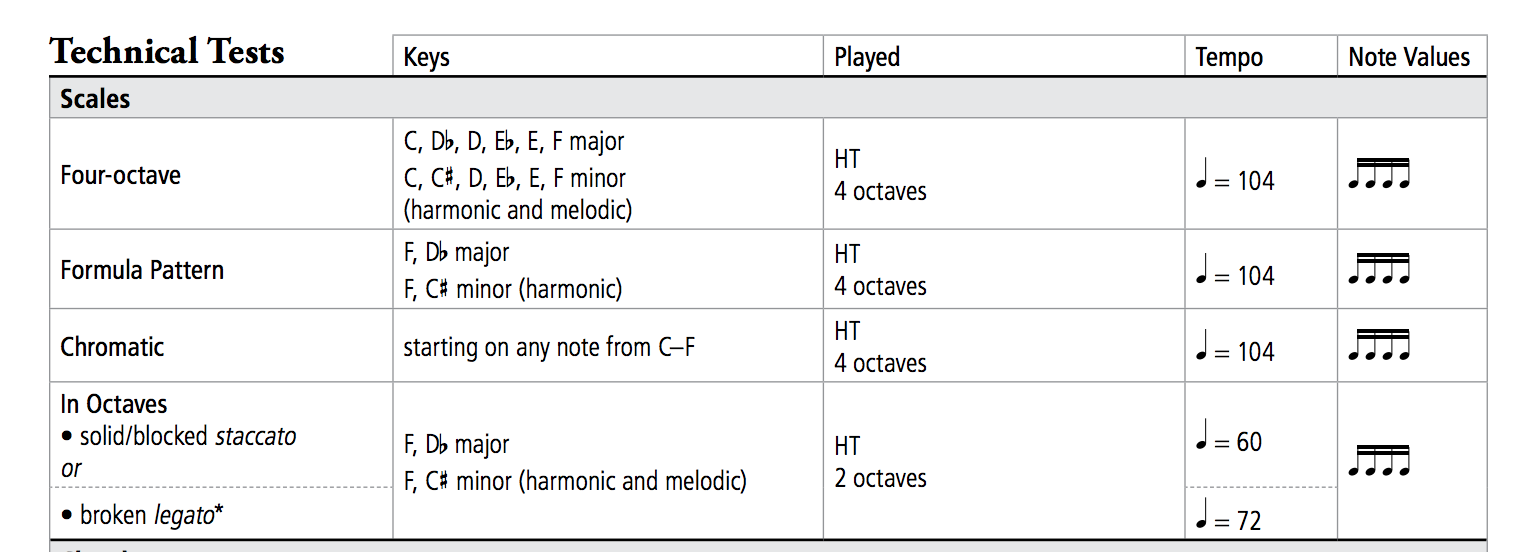
TECHNIQUE
Level 9
Prepare “Four Octave” at the indicated m.m.
Hands alone if needed
Close loud, high loud, medium (2 notes per tic) then full tempo
READING
Sightreading: 5-10 min a day
Look at the bass first. Why do we do this? It outlines the harmony. We also read intervals from the bass.
CONFIDENCE! Play each note with confidence, even if you know there’s going to be a mistake.
REPERTOIRE
BAROQUE
Sinfonia No. 8 in F Major, BWV 794
Work technically for memory, notes and good texture. We’ll work on Expression next week.
CLASSICAL
ROMANTIC
Chopin: Mazurka in A Minor, Op. posth. 68 No. 2 (L. 8, C)
Edvard Grieg (1843-1907) Poetic Tone Pictures, Op. 3 No. 4, Andante con sentimento (L. 8, C)
Felix Mendelssohn (1809-1847) Gondellied (Barcarole) in A Major (L. 8, C)
Overall, practice without pedal so you can see where you’re taking advantage of it - You play your LH staccato (and RH) when it should be legato.
No surface playing in your LH.
Learn the harmony a bit better
See the PDF I emailed you.
Finish learning.
Practice slowly
Don’t rush LH triplets.
Etude Tableaux, Op. 33 No. 7 in G Minor
Too much sound on first note - what is the pulse?
Think of two pulses before you begin.
think of the motion of your arm in LH.
m. 2 RH prepare the entrance earlier.
Last beat of m. 2 LH you rush,
m. 4 - spread out the descending 16ths after the last melody note in the RH and before the entrance of the LH melody.
m. 4 - LH melody - equal weight and importance to each note.
m. 8 - bring out the circled 16th notes - careful of pedal. Don’t rush this - in fact slow it down a but.
End of m. 12 - take a bit of tie.
mm. 11-12 - really sing the alto and DO NOT rush any of the 16th. MORE BASS.
Last system on on p. 1 - too metronomic.
Arp in m. 16 - more flexible and more grand. Clear peal in the bass.
mm. 19-21 - don’t suddenly shift tempo.
memory mm. 22-23 and SING the top voices of m. 23
Don’t rush the veloce
Page 3 - te
m. 31 - connect the two B-flats.
Not convinced by measures before Tempo 1
mm. 37-38 - connect melody.
Finish learning.
Sprints:
Octave sprints, rotating the landing point through each note of the scale.
Landing point: be proud of the landing.
Between point A and B: Think of point B: Fast as you can and light.
Accents:
Rotate accenting each note of the scale by octave.
Then do every 4 notes. Rotate the accents.
High Loud:
Don’t be careful of your landings.
Staccato:
Fast as you can with accurate notes and balance.
Perform:
Have all the intention in the world and say to yourself that you just did the technical work for it. Do it performance style up to 5 times and own any mistakes.
CONTEMPORARY / POST-ROMANTIC
Repertoire for Review
BAROQUE
Johan Sebastian Bach (1685-1750)
French Suite No. 4 in E-flat Major BWV 815
Allemande (L. 7, A)
Gigue (L. 7, A)
Invention No. 4 in D Minor, BWV 775
Invention No. 8 in F Major, BWV 779
Invention No. 12 in A Major, BWV 783 (L. 8, A)
Invention No. 15 in B Minor, BWV 786 (L. 8, A)
Domenico Scarlatti (1685-1757)
Sonata in E Major, K 531 (L. 8, A)
CLASSICAL
L. V. Beethoven (1770-1827)
Sonata in G Minor, op. 49, no. 1 (L. 8, B)
Sonata in G Major Op 49 No. 2 (L. 8, B)
Friedrich Kuhlau (1786-1832)
Sonatina in C Major Op. 88 No. 1 (L. 7: B)
Wolfgang Amadeus Mozart (1756-1791)
Sonata in C Major, K 545, Allegro (L. 8, B)
ROMANTIC
Johann Friedrich Franz Burgmüller (1806-1874)
The Storm Op. 109 No. 13 (L. 8, Etude)
Frederic Chopin (1810-1849)
Valse Op 69 No. 1 (L. 8, C)
Waltz Op. 69 No. 2 in B minor (L. 8, C)
Edvard Grieg (1843-1907)
Humoreske in C Major Op. 6 No. 3 (L. 8, C)
Robert Schumann (1810-1856)
Album für die Jugend, Op. 68 No. 12 Knecht Rubrecht (L. 8, C)
CONTEMPORARY / POST-ROMANTIC
Claude Debussy (1862-1918)
Children’s Corner:
Doctor Gradus ad Parnassum (L. 10, D)
The Little Shepherd (L. 8, D)
Page d’Album (L. 8, D)
Gabriel Fauré (1845-1924)
Improvisation in C-sharp minor Op. 84 No. 5 from Huit Pièces Brèves (L. 9 Etude)
Sergei Rachmaninoff (1873-1943)
Etude Tableaux, Op. 33 No. 7 in G Minor
Maurice Ravel (1875-1737)
Prelude in A Minor (L. 8, D)
Alexander Scriabin ()
Twenty-Four Preludes, Op. 11 No. 22 by (L. 8, D)
Sergei Prokofiev ()
Op. 65 No. 6 Waltz (L. 7: C)
Op. 65 No. 12
J. S. Bach: Little Prelude in C Major, BWV 933 (L. 7)
Granados, Cuentos de la juventud Op. 1 No. 9: La huerfana (L. 7)
Mignon Op. 68 No. 36 by Robert Schumann (1810-1856) (L. 6 List C)
Diabelli, Sonatina in F Major Op. 168 No. 1, movement III (L. 6 List B)
Kabalevsky, Toccatina Op. 27 No. 12 (L. 6) (1904-1987)
Haydn Hob.XVI No. 8
Burgmuller Op. 109 No. 7 Berceuse
Kabalevsky Etude in A Minor
Beethoven Sonatina in F Major Anh 5 No. 2
Bach Invention No. 8
The Happy Farmer Op. 68 No. 10 by Robert Schumann (level 4)
Sweet Sorrow Op. 100 No. 16 by J. F. Burgmuller (level 5 etude)
Foggy Bottom Blues (level 4)
Bartok Sonatina Sz. 55: 1. Bagpipers (recital
Scarlatti Sonata in C Major K 159 (recital)
Dragon Fly (Etude L. 4)
Clementi, Six Sonatinas Op. 36
Arabesque Op. 100 No. 2 by Johann Friedrich Burgmüller (L. 3 Etude)
Musette in D Major by J.S. Bach (L. 3 List A)
Sonatina in A Minor Op. 94 No. 4 by Albert Biehl (L. 3 List B)
Clementi, Sonatina Op. 36 No. 1 in C Major
Faure Dolly Suite
Kuhlau, movement 2
*"Allegro in B-flat" by W. A. Mozart
Sonatina in G Major by Beethoven
**Adieu by Bergmuller
**Chanson Italienne Op.39 No. 15 Tchaikovsky
Pastorale by Bergmuller
__________________________________________
Kaufman Piano Competition: applications by March 1st
JUNIOR DIVISION 2: AGES 11-14
Preliminary YouTube Round: Up to 15 minutes of music,
Contestant's choice. (Needs to include at least one fast-paced work.)
Semi-Final Round: Up to 20 minutes
1. One Baroque polyphonic work
2. One virtuoso etude by Czerny, Clementi, Moszkowski, Chopin, Liszt, Rachmaninoff, etc.
3. One or more pieces at the participant's discretion
Finals: Up to 25 minutes
1. A Classical sonata (or first or last movement)
2. One or more compositions from the Romantic era
3. One or more Contemporary pieces, written after 1950
One work from semi-final round may be repeated.
Works from preliminary round can be performed at the semifinal or the final rounds.
Repertoire Goals
Counterpoint
Bach Invention No. 8
Bach Gigue from French Suite…
Scarlatti Sonata K…
Handel Movement from Suite…
Bach Invention No…
Etudes
Kabalevsky Etude in A Minor Op. 27 No.8
Due November 8th
*Burgmuller Op. 100 No. 23 Le Retour
(repeated chords)
*Burgmuller Op. 109 No. 1 Confidence
*Burgmuller Op. 109 No. 8 Agitato
Rotating balance
*Burgmuller Op. 109 No. 10 La Vélocité
16th note Passage work
*Burgmuller Op. 109 No. 14 Refrain du Gondolier
*Burgmuller Op. 109 No. 18 La Fileuse
Mendelssohn Op. 140
Clementi…
Czerny Op. 740
Moszkowski Op. 72 No. 1…
Sonatinas
Clementi Op. 36 No. 4
Performance Ready on November 8th
Diabelli Op. 151 or 168
Clementi Op. 36 No. 5
Haydn Hob.XVI No. 8 or No. 7
Kuhlau Op. 20 No. 1, Op. 55 No. 3, 4 or Op. 88 No. 4
Clementi Op. 36 No. 6
Contemporary / Modern - Late 19th & 20th Century
Kabalevsky
Prokofiev
Debussy
ROMANTIC
Paderewski: Humoresque de Concert “Minuet”
Contemporary / Modern - Post 1950
Mendelssohn Op. 30 No. 6 "Venetian Boat-Song No. 2"
Moszkowski, Vingt Petites Etudes Op. 91 No. 10, 11
2018-2019 Goals
Jr. High applications - which schools?
Kaufman Competition
JUNIOR DIVISION 2: AGES 11-14
Preliminary YouTube Round: Up to 15 minutes of music,
Contestant's choice. (Needs to include at least one fast-paced work.)
Semi-Final Round: Up to 20 minutes
1. One Baroque polyphonic work
2. One virtuoso etude by Czerny, Clementi, Moszkowski, Chopin, Liszt, Rachmaninoff, etc.
3. One or more pieces at the participant's discretion
Finals: Up to 25 minutes
1. A Classical sonata (or first or last movement)
2. One or more compositions from the Romantic era
3. One or more Contemporary pieces, written after 1950
One work from semi-final round may be repeated.
Works from preliminary round can be performed at the semifinal or the final rounds.All application materials must be postmarked by March 1, 2019 and submitted by mail and/or email to: