
2026-2027 Events
October 17-18, 2026 — Group Classes
December 5-6, 2026 — Group Classes
January 24, 2027 — Performance Class & Guest Artist Workshop
February 27-28, 2027 — Group Classes
April 10-11, 2027 — Group Classes
May 22, 2027 — Student Final Recital
Rotate, Time It, Log It
Start at the top of the list and work down. Stop partway? Start there the next day, and keep rotating.
Order: technique, technical requirements, theory, musicianship, Four Star, repertoire.
Assignments with a time cap show it at the top. Set a timer and stop when it's up.
Repertoire has no cap. Rotate through the pieces instead of spending the whole session on one.
Before each item, start the stopwatch. After it, post a comment with the item and the minutes, then move on.
iPad only when the assignment is in Newzik or in the blog. Otherwise work off the page and time yourself honestly.
Logging starts October 1. Awards at every group class: most consistent logger (days, not minutes), and most minutes.
This week: 539 minutes over 9 days. Almost all of it repertoire. Technical requirements got zero.
Technique
1. 🟩 The Virtuoso Pianist, No. 1, by Charles-Louis Hanon (1819-1900)
⏱ Max 4 minutes per session. Start the stopwatch.
Same sections: mm. 12–17 and the last few measures.
Close-loud: you have this one.
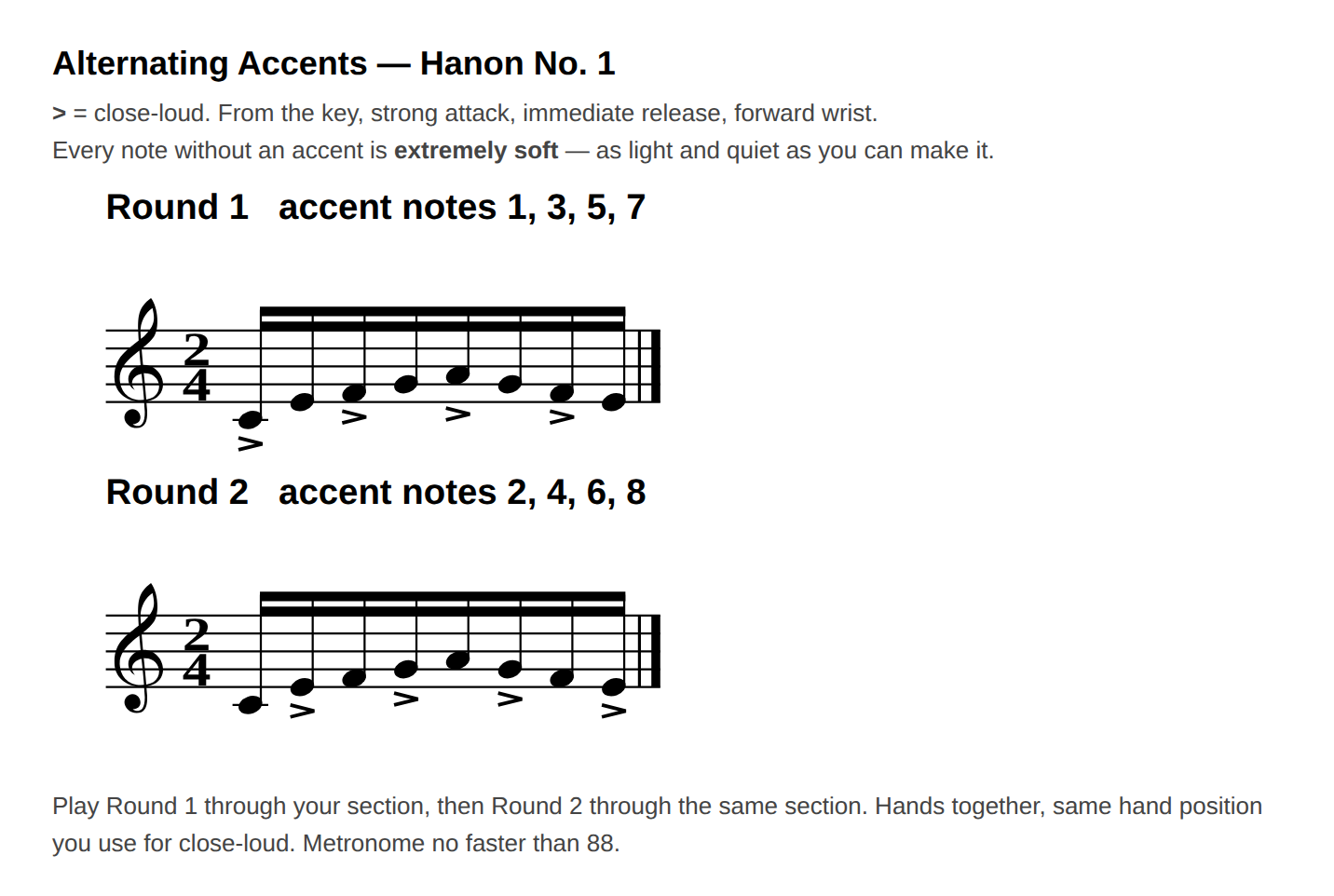
Alternating accents (new): accent every other note close-loud, and make the notes in between extremely soft. Then rotate the accent onto the other notes.
Keep good position. It got chaotic when you sped up.
Metronome no faster than ♩ = 88.
Watch the video before you practice it.
Mom checks: the wrist releases forward on the close-loud notes. A still wrist means tension.
🎥 Alternating Accent Practice
💬 Log it: Hanon + minutes.
2. 🟩 RCM Technical Requirements: Level 3
⏱ Max 5 minutes per session. Start the stopwatch.
Rotate through every Level 3 item. Work from the table on page 4: scales, formula pattern, chromatic, tonic triads broken and solid.
Two octaves, hands together, ♩ = 80, two notes per beat.
🟩 D major · 🟩 F major
🟨 B-flat major
🟨 B minor, D minor, G minor — harmonic and melodic
Think the scale through before you start it. Fingers close to the keys.
💬 Log it: RCM technique + minutes.
Theory
3. ⬛️ Theory Level 4
Coming later. Don't start it.
Musicianship
4. 🟩 Sight-Reading 2B
⏱ Start the stopwatch. One page per session.
Pages 85–90. We finish the book next time.
💬 Log it: Sight-reading 2B + minutes.
5. 🟩 Four Star Level 3
⏱ Start the stopwatch. One day of the set per session.
Finish Set 9, then do Set 10.
💬 Log it: Four Star + minutes.
6. 🟩 RCM Moodle (Musicianship Online)
⏱ Max 5 minutes per session. Start the stopwatch.
Clap-backs only. No melody playbacks — those are solid. In the clap-backs, watch the end of the rhythm: that's where the errors are.
You don't have to do them all at once.
💬 Log it: RCM Moodle + minutes.
Repertoire
7. 🟩 Minuet in G Minor, BWV Anh. 115, attr. Christian Petzold (1677-1733), from the Notebook for Anna Magdalena Bach (L. 3, A)
⏱ Start the stopwatch.
Expression
Right-hand focus. The left hand is too loud whenever the right hand plays. The right hand has the melody and needs to sit above it.
Ornaments — keep mm. 8, 13, 15, 31
No more full ornament routine. Just start with the wrist at or below the level of the white keys, then drop forward. Every trill that didn't speak today had a high wrist.
Also play mm. 6–9, watching the low wrist going into the ornament. If the thumb sounds wobbly, change the hand position instead of repeating it the same way.
🟨 Starting from random measures
This one needs work. Begin anywhere in the piece, including mid-measure. And when I name a measure, start where I ask.
Practice performances
When you play something all the way through for me: no stopping, no fixing, no changing the tempo. Spotting is different — stopping is fine there.
💬 Log it: Minuet in G minor + minutes.
8. 🟩 Sonatina in A Minor, Op. 94, No. 4, first movement: Allegro moderato, by Albert Biehl (L. 3, B)
⏱ Start the stopwatch.
Forte sections are much stronger, and the wrist movement looks good.
mm. 15–16. More diminuendo. End the phrase in m. 16 quieter, with a tiny slowdown.
mm. 16–17. More breath between the sections. Do it because you know the phrase has ended, not because it's printed.
mm. 23–25. The left hand sticks in the keys on the half-note chords. Detach them slightly. In m. 25, lift off to restrike so the chord speaks.
Downbeat of m. 1. Be in motion. Hands in your lap, then come in already moving, or the note may not speak.
💬 Log it: Biehl + minutes.
9. 🟩 Sonatina in C Major, Op. 36, No. 1, first movement: Allegro, by Muzio Clementi (1752-1832) (L. 3, B)
⏱ Start the stopwatch.
In good shape, so it goes green.
Assignment: start from random measures, two minutes straight. Pick them yourself, including mid-measure.
Settle the beat in your head before you start. A touch slower than today.
💬 Log it: Clementi + minutes.
10. 🟩 Left Alone by Joyce Grill (L. 3, Etude) — new
⏱ Start the stopwatch.
Your first etude, and a contrasting piece for the set. Left hand alone, so it's easier than it looks.
Assignment: learn the notes, NFPER, in small groups.
The down-stems and up-stems are two voices in one hand. mm. 1–4: the bass notes are the melody. End of m. 4 through m. 12: the up-stems are. Write that in the book.
💬 Log it: Left Alone + minutes.
11. ⬛️ Étude in D Major, Op. 37, No. 17, by Henri Lemoine (1786-1854), from 50 Études enfantines (L. 3, Etude)
Your second etude, the one you picked. Don't start it yet.
12. 🟪 Musette in D Major, BWV Anh. 126, Anonymous, from the Notebook for Anna Magdalena Bach (1725) (L. 3, A)
⏱ Start the stopwatch.
Whole piece: no locking wrist. Loosen up the way you do for the trills.
mm. 3 and 7 — drop the wrist into the first note, like the ornaments in the Minuet. That should tidy the attacks on its own.
Start from three different random measures each session, sometimes mid-measure.
💬 Log it: Musette + minutes.
13. 🟪 Lemon Sherbet Rag by Barbara Arents (L. 3, C)
⏱ Start the stopwatch.
Whole piece: wrist always in motion, never locked. Same as Hanon and the Biehl.
Near the beginning there are still moments where the wrist stops. Catch those.
Metronome ♩ = 108, then 112, then 116.
💬 Log it: Lemon Sherbet Rag + minutes.
14. 🟪 The Stormy Sea by Anne Crosby Gaudet (L. 3, C)
⏱ Start the stopwatch.
Come off with hand and foot quickly on the last note.
💬 Log it: Stormy Sea + minutes.
Focus Tracker
💚💚💛💛💚💛💜❤️💚💚💜❤️💚💜❤️🖤❤️❤️💚💚💚💚💚❤️💚💚🖤🧡💚💚💚💚🧡💚❤️🧡❤️💚💚💚💚💛💚❤️
(53 points)
❤️ = 4 POINTS (+ bonus = no reminders)
💚 = 3 POINTS
💛 = 2 POINTS
💜 = 1 POINT
🖤 = 0 POINTS
I Spy Practice Video
HERE IS THE LINK TO I SPY PRACTICE VIDEO
Review List
Review these with your music, one time each week.
RCM Level 2
Écossaise in G Major, WoO 23, by Ludwig van Beethoven (1770-1827) (List A)
I Spy by Melody Bober (b. 1955) (List B)
Farewell, Op. 98, No. 4, by Alexander Gretchaninoff (1864-1956) (List B)
Etude in D Minor, Op. 82, No. 65, by Cornelius Gurlitt (1820-1901) (Etude)
RCM Level 1
German Dance in D Major, Hob. IX:22, No. 2, by Franz Joseph Haydn (1732-1809) (List A)
This Guy's Disguised by Bradley Sowash (List B)
Cranky Cat by Teresa Richert (b. 1964) (List C)
Far Away by Teresa Richert (b. 1964) (Etude)
RCM Preparatory B
Looking-Glass River by Nancy & Randall Faber
New Shoes by Linda Niamath
Raptors by Kevin Olson
Leaping the Waves with Dolphins by Barbara Arens
RCM Preparatory A
Marching, Op. 39, No. 3, by Dmitri Kabalevsky (1904-1987)
Curious Cat by Teresa Richert (b. 1964)
The Lively Boy