
2026-2027 Events
October 17-18, 2026 — Group Classes
December 5-6, 2026 — Group Classes
January 24, 2027 — Performance Class & Guest Artist Workshop
February 27-28, 2027 — Group Classes
April 10-11, 2027 — Group Classes
May 22, 2027 — Student Final Recital
Rotate, Time It, Log It
Start at the top of the list and work down. Stop partway? Start there the next day, and keep rotating.
Assignments with a time limit show it at the top. Set a timer and stop when it's up.
Before each item, start the stopwatch. After it, post a comment with the item and the minutes, then move on.
Only log what you actually did, on the day you did it. No estimating ahead. If something doesn't get done, we leave it purple and look at it next time. The competition runs on the same rules for everyone.
Logging starts October 1. The Practice Logging page on the website has the instructions.
This week: 351 minutes over 8 days, and nothing on the list went unpractised. Great consistency, except both Tuesdays. The RCM online got the least: 10 minutes over 2 days, when it's a three-day assignment.
Technique
1. 🟩 Level 4 RCM Technique
⏱ 5 minutes per day. Start the stopwatch.
You're through page 13 and the solid and broken chords. Now do all of the chords, including the ones that look too hard. Bring me those.
Arpeggios: we start them next lesson. Leave them for now.
Everything has to be memorized for the exam. If I ask for a formula pattern, play it without the music.
Track it on page 6 with the writing tool: check off each item as you do it, then erase and start again.
Exam session: November 28 – December 10.
💬 Log it: Level 4 technique + minutes.
Theory
2. 🟪 Theory Level 4: Unit 8
Unit 8 is done, which finishes the level. We didn't check it today, so bring it next lesson and we'll go through it together.
Musicianship
3. 🟩 RCM Musicianship Level 4 Online
⏱ Three days a week, max 10 minutes per session. Start the stopwatch.
Get all three days in. Melody playbacks only, and this is now the only place they live. Your clap-backs and playbacks are both getting better.
Login: info@gledhillartscollective.com – dust2789
💬 Log it: RCM online + minutes.
4. 🟩 Sight-Reading 3A
⏱ Start the stopwatch. One per session.
Pages 47–52. Splitting a two-day page across two days is exactly right.
💬 Log it: Sight-reading 3A + minutes.
5. 🟩 Four_Star_04_06
⏱ Start the stopwatch. One day of the set per session.
Set 6 is done. Move on to Set 7.
💬 Log it: Four Star + minutes.
6. 🟩 Note Flash Cards
⏱ Start the stopwatch. 5 rounds of 10 cards per session.
The YouTube video comes off the list — your reading today was clearly better. We're using the Jane Smisor Bastien cards I left with you, low C up to high C.
Shuffle and lay out 10 cards without looking at them.
Head down, good hand position.
Left to right: say the note and play it, as fast as you can.
Shuffle and repeat. Five rounds.
Green rubber band only. Leave the red and blue sets aside.
💬 Log it: Flash cards + minutes.
Repertoire
7. 🟩 25 Études faciles et progressives, Op. 100, No. 15, Ballade, by Johann Friedrich Franz Burgmüller (1806-1874) (L. 4, Etude)
⏱ Start the stopwatch.
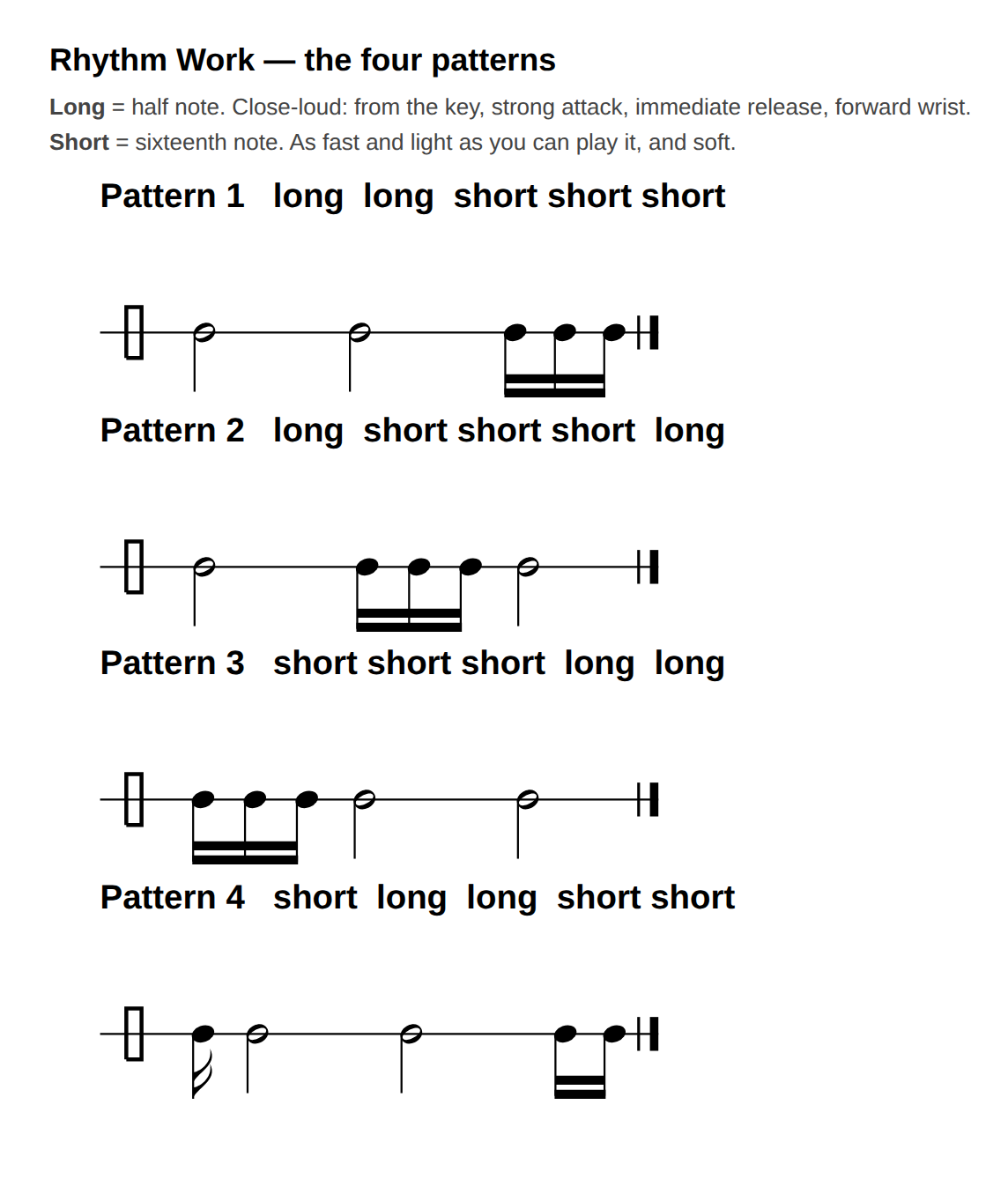
Your strong notes in the right-hand melody have real command in the approach now, and the sixteenth passages sound worked on.
Right-hand thumb
On a close-loud thumb note your wrist drops. Pop it forward instead. That's what was making those notes mushy. If it isn't tidy and fast, do it again before moving on.
mm. 2–3 technical exercise (new) — a few minutes a day
Start in motion, not from still. Still means tense before the first note.
Drop into the key with the left hand in m. 3. At the end of m. 3, lift to the top of the fallboard, repeat m. 2, drop into m. 3 again.
The lift is what keeps the wrist relaxed. Think "easy" on the drop.
Build speed until it's as fast as you can go with control. Lose control, slow down, push it back up.
mm. 87–90 rhythm work — three shorts, 3 to 5 minutes a day
Same idea, with an extra short note. Keep using your mother's highlighter system.
Long notes are close-loud: from the key, strong attack, immediate release, forward wrist. Short notes as fast and light as you can play them, and softer — that's the part still missing. Prepare before each long note, then go. It should feel like effort. If it feels easy, it's wrong.
Tempo
mm. 5–6. You sped up. For now, slow 5 and 6 down to match the opening, not the other way round.
Imagine the sixteenths before you start, then set the eighths against them.
mm. 1–2. Left hand in your lap, drop into it first. Bring the hand up in m. 2, not at the last second.
C minor triads in the right hand stay crisp, not mushy. That's the tension in the piece.
💬 Log it: Burgmüller + minutes.
8. 🟩 Sonatina in G Major, Op. 36, No. 2, third movement: Allegro, by Muzio Clementi (1752-1832) (L. 4, B) — back on the list
⏱ Max 10 minutes per session. Start the stopwatch.
This went missing off the blog, which is why you had no List B piece. You've already played it, so there's no new piece to learn and we can move toward Level 5 sooner.
Assignment: get it back in your fingers, hands together.
💬 Log it: Clementi + minutes.
9. 🟩 Album für die Jugend, Op. 68, No. 10, The Happy Farmer, by Robert Schumann (1810-1856) (L. 4, C)
⏱ Start the stopwatch.
Play it through once exaggerating your movements. Be weird about it.
Play it again with the movements smaller, and find the places where you actually want to move because the music asks for it.
What kind of happy farmer is this? Quirky, funny, sincere? Play it like an actor conveying that through your hands, body and face. When you moved a little today, your arms loosened on their own and the sound got better.
Avoid collapsing forward and down. That position wrecks your alignment.
Also: in motion from the start, tidy attacks, left hand commanding at the opening, right hand softer. Treat a run-through as a performance, no stopping for mistakes.
💬 Log it: Happy Farmer + minutes.
10. 🟩 Joyous Etude by Melody Bober (L. 5, Etude)
⏱ Start the stopwatch.
mm. 24, 25, 26. Lift the right hand at the end of each slur for breath. Two places per measure in 24 and 25.
m. 12. The left-hand downbeat is an eighth note, not a sixteenth. Count it.
m. 15. Right hand too fast, the whole measure. It's duple against triple. I'll bring you exercises for it.
m. 29. Don't rush the last two eighth notes, circled in yellow.
Play-through: beginning to end, no pausing, no going back to correct. Getting off between the left-hand eighths and right-hand sixteenths happens. Stay on the beat, fix it after.
💬 Log it: Joyous Etude + minutes.
11. 🟪 Minuet in D Minor, BWV Anh. 132, from the Notebook for Anna Magdalena Bach, attrib. J. S. Bach (L. 4, A)
⏱ Start the stopwatch.
Good work fixing the orange circle in m. 7. Keep thinking about an even pulse.
Spot the endings
First and second endings of each section, back to back, three times each — twelve repetitions in a session, around five minutes.
First section: start at m. 6, play the first ending, back into m. 1. Then from m. 6 again, second ending, on into m. 9.
Second section: start at m. 14, first ending, back into m. 9. Then from m. 14 again, play to the end.
💬 Log it: Minuet in D minor + minutes.
12. 🟪 Masquerade by Linda Niamath (L. 4, Etude)
⏱ Start the stopwatch.
m. 34 — do the fermata.
m. 35 — spot the first two beats in the left hand. Throw the hand up and land light and on time. Use the pedal. Left hand alone 3 times in a row correctly, then beats 1 and 2 hands together 3 times, then start at m. 34 and play through 36.
Not so loud there. It's a mezzo forte.
Pedal, mm. 32–34. Catch the bass note in m. 33 and again in m. 34. Don't put the chord down early.
m. 31 — left-hand arpeggio fingering 5, 4, 2, 1, 4, 2, 1.
💬 Log it: Masquerade + minutes.
13. 🟪 Level 5 Repertoire, List A — to be chosen
I'll bring the Level 5 books next lesson. Nothing to practise yet.
Level 4 Exam Program
List A — Minuet in D Minor, BWV Anh. 132
List B — Sonatina in G Major, Op. 36, No. 2, third movement, Clementi
List C — The Happy Farmer, Op. 68, No. 10, Schumann
Etude 1 — Ballade, Op. 100, No. 15, Burgmüller
Etude 2 — Masquerade, Niamath
Joyous Etude is a Level 5 etude, so it stays out of the Level 4 program.
Review Pieces
Level 2
List A: Minuet in G Major, BWV Anh. 114, attr. Christian Petzold (1677-1733), from the Notebook for Anna Magdalena Bach
List B: Sonatina in G Major, Anh. 5, No. 1, II. Romanze, attr. Ludwig van Beethoven (1770-1827)
List C: Play by Béla Bartók (1881-1945), from Mikrokosmos
Etude 1: Prelude No. 4 in F Major by Elvina Pearce
Etude 2: L'Arabesque, Op. 100, No. 2, by Johann Friedrich Franz Burgmüller (1806-1874)
Bird in the Bebop by Wynn-Anne Rossi (L. 2, Etude)
Etude in F Major, Op. 190, No. 27, by Christian Louis Heinrich Köhler (1820-1886) (L. 2, Etude)
A Ditty of Yimeng Mountain (L. 2, C)
Minuet in A Minor by Henry Purcell (1659-1695) (L. 2, A)
Rhyme Time (L. 2, B)
Level 1 and Preparatory
The Snake by Renée Christopher (L. 1, C)
Andante in G Minor by Georg Philipp Telemann (1681-1767) (L. 1, A)
Detectives by Christine Donkin (L. 1, Etude)
Angelfish (L. 1, B)
Celebration by Anne Crosby Gaudet (b. 1968) (L. 1, Etude)
The Calico Cat by Helen Marlais (b. 1966) (Prep. B)
Freddie the Frog by Anne Crosby Gaudet (b. 1968) (Prep. B)
Allegro in C Major, Op. 1, No. 4, by Alexander Reinagle (1756-1809) (L. A)
A Skating Waltz by Boris Berlin (1907-2001) (L. A)
What's That Noise? by Martha Mier (b. 1936) (L. A)
Seasonal
The First Noel, Traditional, arr. Edwin McLean
O Christmas Tree, Traditional
Archive
RCM Level 1 Exam — May 29, 11:01 am
List A: Andante in G Minor, Telemann
List B: Angelfish
List C: The Snake, Christopher
Etude: Detectives, Donkin
Recital May 19, 3:00 pm
Angelfish
Detectives
The Snake
Andante in G Minor
Celebration
September 6, 2026 (7 of 8)
September 6, 2026 · in person
Log your notes during practice in the comment section of this post. Thank you for being so diligent with your logging this past week — you logged every single day, and it made this lesson much more useful.
Technique
🟨Level 4 RCM Technique
5 minutes per day.
Memorize every item. If I ask for the C minor harmonic formula pattern, you should be able to play it without the music. All of the technique has to be memorized for the exam — G minor melodic is one that needs work.
Keeping track: go to page 6 of the technical requirements and use the writing tool. Pick a color and check off each item on the table as you do it, so next time you know exactly where you are. Continue until you've been through the whole thing, then erase and start again.
Solid blocked chords — keep the wrists in motion always. D major is the hard one, because the thumbs land on black keys.
Dates. Registration: September 2. Exam session: November 28 – December 10.
Theory
🟩Theory Level 4: Unit 8
Unit 7 is finished and checked. Do Unit 8 — that finishes the level.
Self-check it first. When you fix an error, mark where you fixed it rather than quietly correcting it.
Musicianship
🟨RCM Musicianship Level 4 Online
Three days a week, no more than 10 minutes each session. That's about 30 minutes over the week — down from the five days you were doing.
Melody playbacks only. Stop doing the rhythm portion; melody is the focus. Put the time you get back into other areas of your practice.
Login: info@gledhillartscollective.com – dust2789
🟩Sight-Reading 3A
Complete pages 42 to 46.
🟩Four_Star_04_06
Set 5 is done. Move on to Set 6.
🟩Note Flash Cards — new
Your note reading has gone rusty, and at Level 5 we can't have that. 😇
I'll send you a link to an online set you can drill. Short and often is better than long and once.
Repertoire
🟩25 Études faciles et progressives, Op. 100, No. 15, Ballade, by Johann Friedrich Franz Burgmüller (1806-1874) (L. 4, Etude)
Real expression coming through now — I can hear that you worked phrase by phrase. About 13 minutes a day total on this one.
Expression
mm. 53–56. Do the diminuendo, and count three beats per measure — you suddenly sped up here. Make the diminuendo even bigger than feels natural; it adds a layer of suspense before the main theme returns at m. 57.
mm. 84–86. Keep these strong.
mm. 87–88. Also keep strong. You're making a decrescendo in m. 87 — it's musically nice, but it isn't what Burgmüller asks for, and it lets the tension go exactly where it should be building.
m. 30. Do the fermata, and don't get softer. Keep the drama.
Memorizing the ending — use your theory
The ending has been hard partly because it's been muscle memory. The piece is in C minor, and the last four measures are all tonic triads — the same chord, moving through different positions (root position C minor, and so on).
Naming the chord and the position gives you something to hold onto if you have a brain bump mid-performance. That's a practical use of the theory you like so much.
Assignment: memorize the key signatures of all of your pieces.
Rhythm work — a new technique
Rhythm work is for passages of successive eighth or sixteenth notes — any fast passage. You rotate where the long and short notes fall:
Pattern1long — long — short — short2long — short — short — long3short — short — long — long4short — long — long — short
The long notes are close-loud notes: from the key, strong attack, immediate release, forward wrist.
The short notes are as fast and as light as you can possibly play them — think of them as grace notes leading into the next long note. While you play them you are already thinking about where you're going to land.
Write L L S S under the notes in your music as a guide, and erase it later. Keep your eyes on the page so you don't lose your place — it's easy to get lost in the patterns.
Check yourself constantly: are the short notes really soft, light and fast? Is the landing really close-loud?
What this trains: independence of the fingers, sprinting from one hand position to another, and playing fast under control. The next step after this is sprint practice — point A to point B, first over two notes, then three, four, five, six. It's tedious, but it's what unlocks real speed.
You can use this anywhere — scales, arpeggios, or anywhere the attacks aren't tidy.
The technical spots — assignment
mm. 3–4 — accent practice, hands together, 3 minutes. Rotate which note receives the accent in each measure. It will be tricky on the weak beats — 2, 4 and 6. Doing it hands together is the missing piece; you've been doing it hands apart.
mm. 3–4 — rhythm work, left hand only, 5 minutes.
mm. 86–89 — rhythm work, hands together, 5 minutes. The left hand already knows how to do this, so it's the right hand joining in that's new.
🟩Minuet in D Minor, BWV Anh. 132, from the Notebook for Anna Magdalena Bach, attrib. J. S. Bach (L. 4, A)
Good work fixing the orange circle in m. 7. Otherwise sounding good — keep thinking about an even pulse.
Spot the endings — assignment
Practise the first and second endings of each section back to back. Three times each, so twelve repetitions in one practice session. Around five minutes, maybe a little more.
First section: start at m. 6, play the first ending and go back into m. 1. Then start from m. 6 again, play the second ending and go on into m. 9.
Second section: start at m. 14, play the first ending and go back into m. 9. Then start from m. 14 again and play to the end.
🟩Masquerade by Linda Niamath (L. 4, Etude)
m. 34 — do the fermata.
m. 35 — spot the first two beats in the left hand. Take a chance and get there faster: throw the hand up and land in the right spot, light. Use the pedal.
Left hand alone, 3 times in a row correctly.
Then beats 1 and 2 hands together, 3 times in a row.
Then zoom out and put it in context — start at m. 34 and play through 35 and 36. Attach the measure before and after the spot.
Not so loud there — it's a mezzo forte.
Pedal, mm. 32–34. Make sure you're catching the bass note in the pedal in m. 33 and again in m. 34. Watch that you're not putting the chord down early.
m. 31 — left-hand arpeggio fingering is 5, 4, 2, 1, 4, 2, 1.
🟩Joyous Etude by Melody Bober (L. 5, Etude)
That section is a lot better than it was.
m. 9 — count. It was rushed, and counting here is what sets up mm. 10 and 11.
m. 15 — the rhythm suddenly gets faster. The triplets make it tricky. With the metronome, listen to the left hand, not the right — the left hand is just half notes, so line up beats 1 and 3 with the click, then space the triplets out inside that.
m. 23 — left hand staccato on the downbeat. Highlighted in yellow.
m. 26 — that's a G-sharp in the right hand, not an F-sharp.
m. 29 — the rhythm at the end isn't correct. It's eighth note, quarter note, rest, eighth note, quarter note. Count the last two measures out loud, start really slowly, and speed it up only once the rhythm is right.
🟪Album für die Jugend, Op. 68, No. 10, The Happy Farmer, by Robert Schumann (L. 4, C)
5 minutes per session.
3 times through: RH alone, LH alone, then hands together.
A phrase or a chunk at a time.
🎨 Color-Focus Practice (NFPER)
At the top of your music, write NFPER using the following color system:
N – Notes – correct pitches and accidentals (🟥 Red)
F – Fingering – consistent, effective finger choices (🟧 Orange)
P – Position – hand shape, posture, and keyboard geography (🟨 Yellow)
E – Expression – phrasing, dynamics, articulation, tone, etc. (🟩 Green)
R – Rhythm – steady pulse, accurate timing, and rests (🟦 Blue)
✅ If you're only recording audio, just use NER.
Step-by-Step Practice Flow
Record your section once — video is best, but audio is fine too.
Listen back with one color/goal in mind.
As you listen, mark your music using that color anywhere it needs improvement.
Repeat for each remaining color, one at a time, until all five have been addressed.
Choose a small "spot" section from your markings — just a few measures or a tricky passage.
"Spot" until it's solid — ✅ 3 times in a row correctly, or ✅ 5 total correct repetitions, then move on.
Focus on one or two colors at a time while practicing that spot.
Use the troubleshooting checklist below if you're stuck.
🔧 Troubleshooting Tips
🎯 If you've tried to fix something three times in-a-row and it's still not working, don't just repeat it — troubleshoot:
Do you need to slow down?
Should you practice hands alone?
Could you make the spot even smaller?
Would technical exercises help (staccato, accents, etc.)?
Do you need to think ahead more clearly?
REVIEW PIECES
💚The First Noel, Traditional, arr. Edwin McLean
💚Bird in the Bebop by Wynn-Anne Rossi (L. 2, Etude)
2, List A: Minuet in G Major, BWV Anh. 114, attr. Christian Petzold (1677-1733)
2, List B: Sonatina in G Major, Anh. 5, No. 1. II. Romanze, attr. Ludwig van Beethoven (1770-1827)
2, List C: Play by Béla Bartók (1881-1945)
2, Etude 1: Prelude No. 4 in F Major by Elvina Pearce
2, Etude 2: L'Arabesque, Op. 100, No. 2 by Burgmüller
O Christmas Tree
Etude in F Major, Op. 190, No. 27 by Christian Louis Heinrich Köhler (1820-1886) (L. 2, Etude)
💚A Ditty of Yimeng Mountain (2, C)
💚Minuet in A Minor by Henry Purcell (1659-1695) (2, A)
💚Rhyme Time (2, B)
💚The Snake by Renée Christopher (L. 1, C)
💚Andante in G Minor by Georg Philipp Telemann (1681-1767) (L. 1, A)
💚Detectives by Christine Donkin (L. 1, Etude)
💚💜Angelfish (L. 1, B)
💚Celebration by Anne Crosby Gaudet (L. 1, Etude)
💜💚💚The Calico Cat by Helen Marlais (b. 1966) (Prep B)
💚💚💚Freddie the Frog by Anne Crosby Gaudet (b. 1968) (Prep B)
💚💚💚Allegro in C Major, Op. 1, No. 4 by Alexander Reinagle (1756-1809) (L. A)
💚💚💚A Skating Waltz by Boris Berlin (1907-2001) (L. A)
💚💚💚What's That Noise by Martha Mier (b. 1936) (L. A)
RCM Level 1 Exam — May 29, 11:01 am
List A: Andante
List B: Angelfish
List C: The Snake
Etude: Detectives
Recital May 19, 3:00 pm (or 1:00 pm if possible)
Angelfish
Detectives
The Snake
Andante
Celebration