
RCMCP
Exam: Piano - Level 3
Exam Confirmation No.: 5391486
Scheduled for: Thursday, 09 December 2021 2:00 PM
List A: Johann Ludwig Krebs, Harlequinade, Suite No. 3 in E-flat Major (L. 3, A)
List B: Clementi
List C: Wild Mignonette Op. 205 No. 1 by Cornelius Gurlitt (1820-1901) (L. 3, C)
Etude: Burgmüller, Op. 100 No. 2, l’Arabesque (L. 3, Etude)
Etude: Grill, Left Alone (L. 3, Etude)
Lesson Assignments
🟢 - On the right track, great work!
🟡 - On the right track but it needs detailed attention.
🔴 - This was not prepared or it needs a lot of attention and focus this week.
⚫️ - No assignment this week. Do not practice this item.
🟣 - We didn’t get to this item but we may look at it next week.
Technique
Hanon No. 2 in C Major
🟡🟢🟢🟢🟣🟡🟣🟢
SPEED BUILD to m.m. 84 per quarter note.
Descending:
Accent practice the 4th note in the pattern of 8
Do the same thing above but with the 5th and then 6th notes.
Clean up notes 4-6 of the pattern in the LH descending.
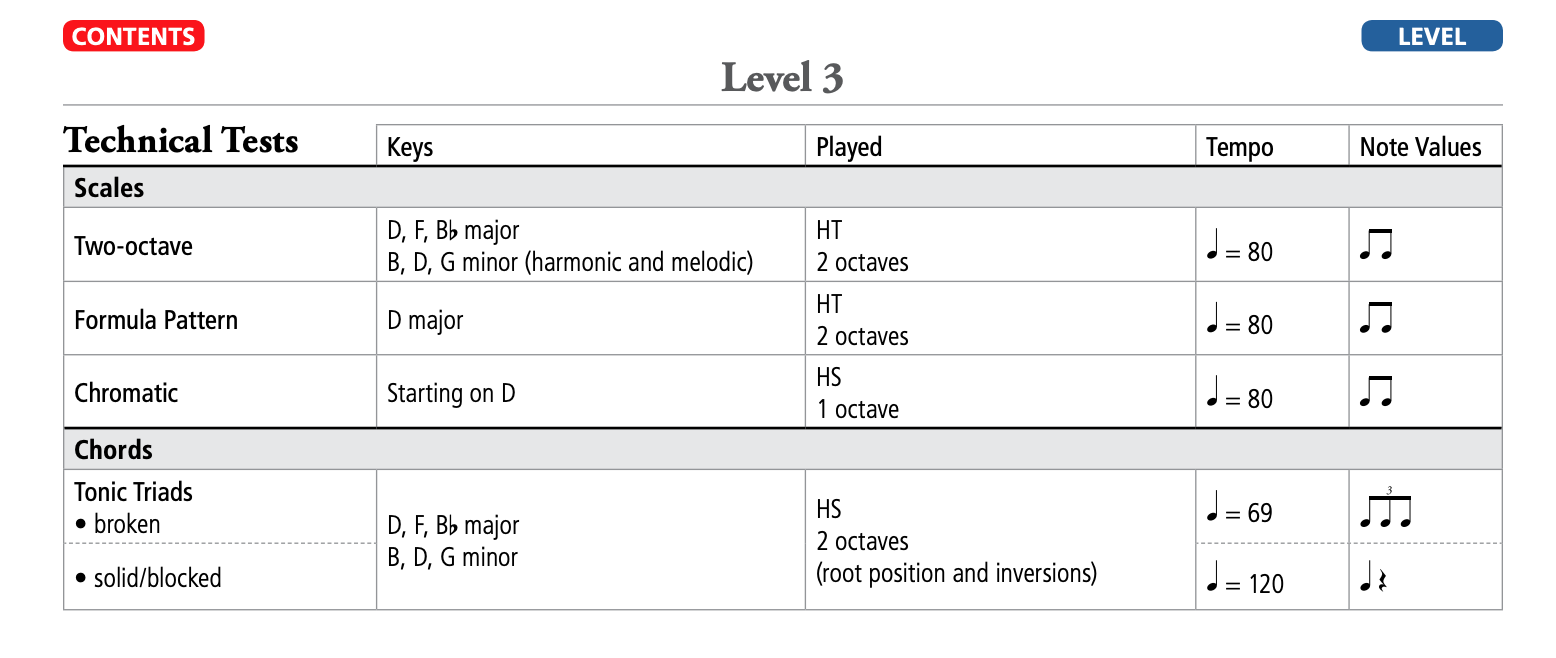
Technical Requirements Level 3
🔴🟣🟢🟢🟣🟢🟣🟢
PRACTICE EACH ITEM 3 TIMES IN-A-ROW CORRECTLY!
Tonic Triads.
RH FINGERING: Use finger 2 for FIRST INVERSION
LH FINGERING: Use finger 2 for SECOND INVERSION
Scales:
WORK FOR TIDY ATTACKS
PLAY CLOER TO THE BLAK KEYS
CHECK ALL YOUR TEMPO AND USE THE METRONOME.
Theory
⚫️Celebrate Theory: Level 3, UNIT 6
(Hold)
Pick up from page with Dustin
FIX PURPLE PEN
Musicianship
Four Star Sightreading and Ear Tests Level 3
🟢🟢🟢🟢🟣🟢🟡
Go back to the beginning and start doing Set 1 and on again.
Do the tests with Dustin at the lesson.
Go online to work especially on the clapbacks.
Online Ear Training and Rhythm
🟢🟢🟢🟢🟣🟢🟡
Focus is CLAPBACKS
https://moodle.rcmusic.com/lms/my/
Click “Piano Teacher Courses”
Login Infoinfo@gledhillartscollective.com
dust2789
Piano Adventures Sightreading Level 3A
🟢🟣🟢🟣🟢🟣🟢🟣🟢
Move on from page 31
m.m. 40 - 60 no faster than this
In your mind, clap and ta the rhythm before you start.
Repertoire
Arabesque
🟢
Mm. 1-10 and 26b - end:
Close Loud: (relax immediately after the attack) 3 times each day.
Staccato Practice: (all notes in the LH are staccato) 2 times each day.
Speed Building: start at m.m. 72, 76, 80, 84, 88, 92, 100, 108, 116, 120, 126
with each tempo, make sure ALL of NFRPE is there before you move on to the next tempo.
Mm. 11-16
Close Loud: (relax immediately after the attack) 3 times each day.
Staccato Practice: (all notes in the LH are staccato) 2 times each day.
Accent Practice: (rotate the 2nd and the 4th note in each group of four 16th notes). 1 time each day
Speed Building: start at m.m. 72, 76, 80, 84, 88, 92, 100, 108, 116, 120, 126
with each tempo, make sure ALL of NFRPE is there before you move on to the next tempo.
Left Alone
🟢
See the yellow and purple markings:
Exaggerate the melody and the accompaniment. Focus on smooth and consistent sound with each one, pretending that two hands are playing!
Gurlitt, Wild Mignonette (L. 3, C)
🟢🟢🟢🟡🟢
See the purple pen (and the blue pen)
Listen to the recording “mm. 14-17”
Expression / Stage Presence at the end.
Tajcevic, Little Piece No. 7 (Etude, L. 3)
🟢🟢🟡🟣🟢
REVIEW once a day at a medium tempo until AFTER THE 9th of December.
Possible New Pieces
Clementi Op. 36 No. 1 vivace (L. 3, B)
Attwood - Sonatina. L. B
Bach, Musette in D Major (L. 3, A)
Lemoine, Etude in D Major (Etude, L. 3)
Kabalevbsky, Clowns (L. 3, C)
Start to learn with NFRPE chart.
Gavotte in G Major HWV 491 by George Frederic Handel (L. 3, A)
🟢🟢🟣🟢🟣🟢
See the purple pen
Listen carefully to the recording in Newzik every day. Try to play like it. Expression is our focus.
Memorize
Clementi Sonatina Op. 36 No. 1 in C Major - Movement 1 (L. 3, B)
🟢🟢🟡🔴🟡🟡🔴🟡🟡
M.M. 88 is your final tempo but DO NOT PRACTICE at this tempo this week.
Record yourself playing and go directly to “spot” any section that needs work in terms of NFRPE.
Listening Assignments
🟢Beethoven’s 32 Piano Sonatas
https://youtube.com/playlist?list=PLNEfi9hag0PZ1QSlanqw9PySdR1Aflz1e (Pianist Richard Goode)
Listen to Sonata No. 1 in F Minor.
Listen for the characters in the sonata. When do they come back? What do they do in the middle?
⚫️Bach Inventions
Your preferences are No. 6, 7, 9 and 10. Perhaps we can learn No. 10 and 6 because they are related keys with one sharp.
Review Pieces
🟢Johann Ludwig Krebs, Harlequinade, Suite No. 3 in E-flat Major (L. 3, A)
🟢Burgmüller, Op. 100 No. 2, l’Arabesque (L. 3, Etude)
🟢Left Alone by Joyce Grill (L. 3 Etude)
🟣Nakada, The Song of Twilight (L. 3, C)
🟢Canon in A Minor by Cornelius Gurlitt (1820-1901)
🟢Invention in A Minor by Renée Christopher (L. 2, C)
🟣Franz Joseph Haydn (1732-1809) German Dance in B-flat Major Hob. IX:22 No. 5 (L. 2, A)
🟣Edna-Mae Burnam (1907-2007) Colored Windows (L. 2 Etude)
🟣Alexander Gedike (1877-1957) Etude in C Major Op. 36 No. 22 (L. 2, Etude)
🟣The Highlands by Christopher Norton (b. 1953) (L. 2 Etude)
Review Once a Week with your Music
CLASSICAL
Wolfgang Amadeus Mozart (1756-1791)
Minuet in F Major K. 2 by (L. 1, A)
CONTEMPORARY
Béla Bartók (1881-1945)
For Children, Book 1, No. 1 and 2 (L. 2, B)
(recital) Etude in C Major by Felix le Coupey (L. 1 Etude)
Skating Waltz
Distant Chimes.
Canon by Carleton Elliot (1928-2003) (L. 1, C)
(3/23) Detectives by Christine Donkin (L. 1 Etude)
(3/23) German Dance in D Major by F. J. Haydn (Level 1. A)
Angelfish (Level 1. B)
HOLD
Czerny Op. 823
we left off on no. 8
Rhythm Book.
PREPARE: Nos. 43-45 on page 23