
2019-2020 Private Lesson Enrollment: Semester
Lesson Assignments
Technique - START YOUR PRACTICE WITH THIS
Level 2 Technique Test:
80% Accurate today.
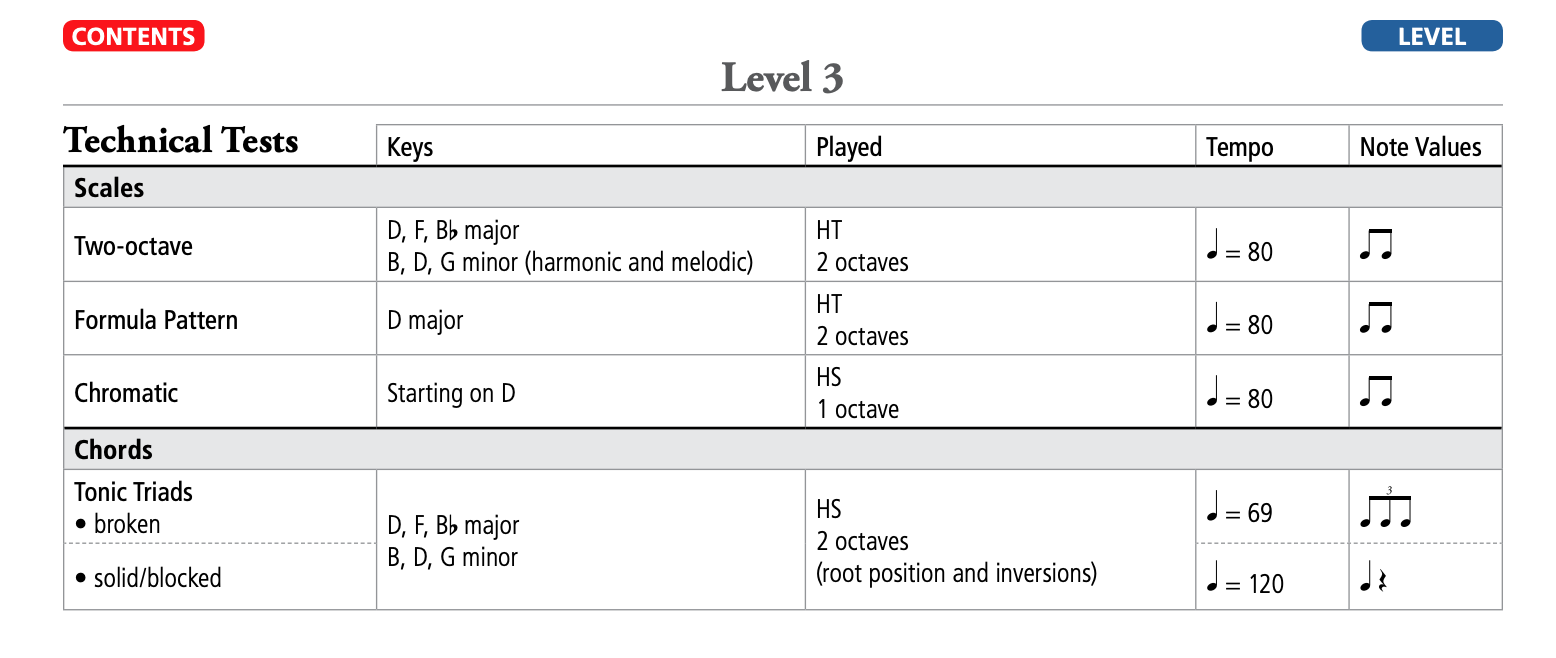
Technical Requirements Level 3
SCALES: Learn **B abd D Minor harmonic and melodic.
Look where finger 4 plays in each hand BEFORE YOU START.
Also listening for tidy attacks.
Theory
*Celebrate Theory: Level 3
Emailed to me on December 22pol
Finish Unit 3 and email me your work
Musicianship
Online Ear Training and Rhythm
https://moodle.rcmusic.com/lms/my/
Click “Piano Teacher Courses”
Login Infoinfo@gledhillartscollective.com
dust2789
Four Star Sightreading and Ear Tests Level 3
Prepare Review Set 2
Prepare Set 1
Sightreading Level 2A
Move on from page 70
m.m. 40 - 60 no faster than this
In your mind, clap and ta the rhythm before you start.
Repertoire
Keyboard Settings: 100%
Zoom Input: 45%
Recital:
A Skating Waltz, Boris Berlin
Very good tempo!
Keep tidy attacks with your 3rds
Minuet in F Major, Mozart (Jan 16)
Do a slight ritardando at the end.
German Dance in B-flat major, Haydn (Jan 16)
Take more time before you start to think about the balance you need to play the 16th notes.
mm. 9 and 11 - you’re rushing your quarter notes.
Angelfish by Anne Crosby-Gaudet
Think about the beginning before you start this to create an atmosphere appropriate for the pieces.
Decrescendo more at the end.
Beautiful decrescendo after the climax!
We Three Kings of Orient Are (Jan 12th)
m. 12 pedaling! Please fix this. Do it 10 times in-a-row correctly.
Unstable memory: mm. 29-32
For Children, Book 1, No. 2, Bartok (Jan 16)
Hungary - how do you pronounce
Your ritardando at the end is too much
Canon by Cornelius Gurlitt
Metronome practice. This was a bit rushed.
Invention in A Minor, by Frederick Silverster
Alexander Gedike (1877-1957) Etude in C Major Op. 36 No. 22 (L. 2, Etude)
Imagine yourself playing the 8th notes perfectly before you begin.
Colored Windows, Eda Mae Burnam (Jan 12th
Keep your head toward the piano until you finish the sound.
The same instruction applies when you’re speaking toward the camera.
The Highlands by Christopher Norton (b. 1953) (L. 2 Etude) (Jan 12th)
The beginning is rushed and unsteady. Practice hearing the first several measures in your head before you begin.
Distant Chimes, Jon George
Maybe a bit slower?
The end of the climax needs to be softer and slower.
Repertoire
Burgmuller Arabesque
Keep LH wrist higher on the staccato chords.
Learn RH section B. See markings in your music.
We Three Kings of Orient Are
All Markings Must be fixed!
Spot each of these sections for at least three practice sessions in-a-row.
Canon in A Minor by Cornelius Gurlitt (1820-1901)
Review
Invention in A Minor by Renée Christopher (L. 2, C)
Reivew.
Franz Joseph Haydn (1732-1809) German Dance in B-flat Major Hob. IX:22 No. 5 (L. 2, A)
Review
Edna-Mae Burnam (1907-2007) Colored Windows (L. 2 Etude)
REVIEW
Alexander Gedike (1877-1957) Etude in C Major Op. 36 No. 22 (L. 2, Etude)
REVIEW
The Highlands by Christopher Norton (b. 1953) (L. 2 Etude)
REVIEW
Review Once a Week with your Music
CLASSICAL
Wolfgang Amadeus Mozart (1756-1791)
Minuet in F Major K. 2 by (L. 1, A)
CONTEMPORARY
Béla Bartók (1881-1945)
For Children, Book 1, No. 1 and 2 (L. 2, B)
(recital) Etude in C Major by Felix le Coupey (L. 1 Etude)
Skating Waltz
Distant Chimes.
Canon by Carleton Elliot (1928-2003) (L. 1, C)
(3/23) Detectives by Christine Donkin (L. 1 Etude)
(3/23) German Dance in D Major by F. J. Haydn (Level 1. A)
Angelfish (Level 1. B)
HOLD
Czerny Op. 823
we left off on no. 8
Rhythm Book.
PREPARE: Nos. 43-45 on page 23