
* = Assignment is a priority for the following week
** = Assignment was not prepared two weeks in-a-row
Repertoire Goals
Etudes
Burgmuller Op. 100 No. 5 Innocence
Burgmuller Op. 100 No. 7 Le Courant Limpide
Burgmuller Op. 100 No. 8 La Gracieuse
Burgmuller Op. 100 No. 9 La Chasse
Burgmuller Op. 100 No. 11 La Bergeronnette
Lesson Assignments:
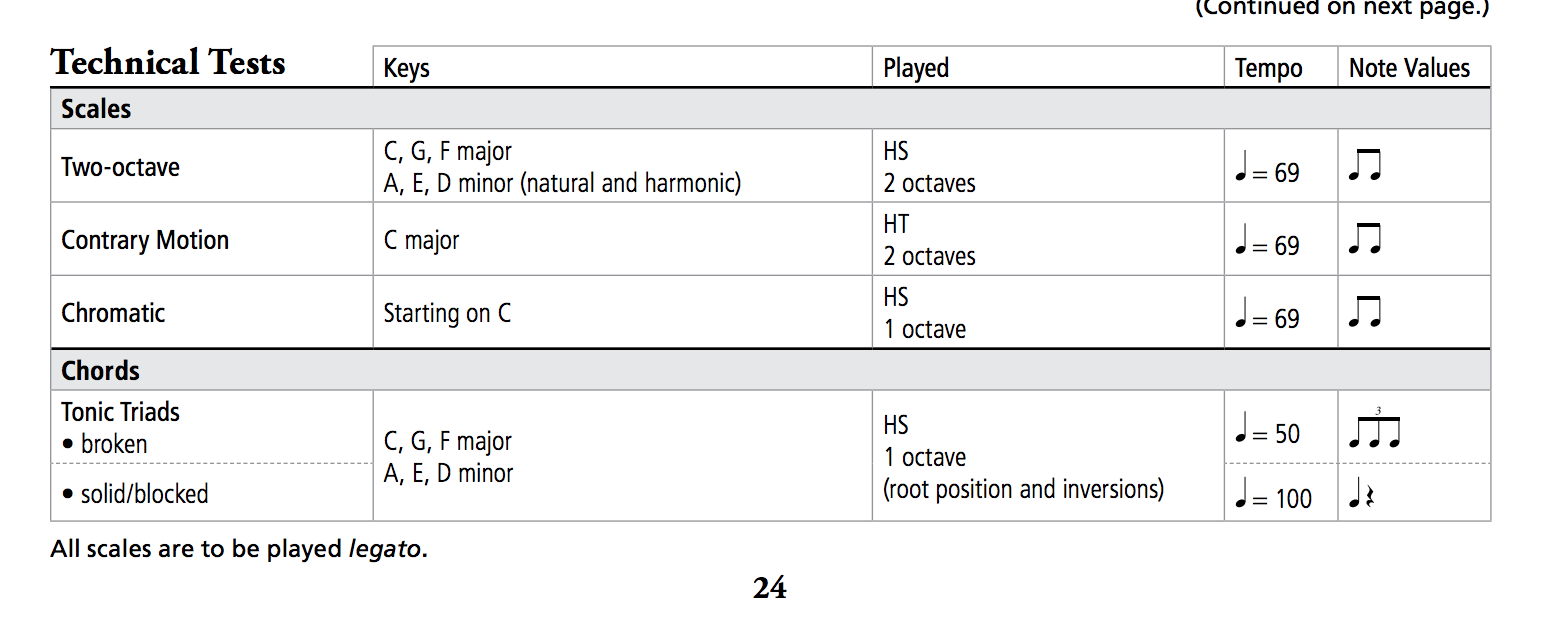
TECHNIQUE
LH Chromatic fingering
Root / Tonic - the first degree of the scale. A major scale, the root and tonic are A
Bass - the lowest note of the chord.
Fingering for Tonic Triads
Root - RH 1, 3, 5 - LH, 5, 3, 1
!st Inversion - RH, 1, 2, 5 - LH, 5, 3, 1
2nd Inversion - RH, 1, 3, 5 - LH, 5, 2, 1
Articulation for Tonic Triads - broken
Apply one phrase to the entire exercise
RCM Repertoire Level 1
List A: German Dance
List B:
Etude: Celebration
Practice Tools
Close Loud
With each note, keep your fingers close to the keyboard and pop your wrist up to help release the tension created when you hit the key with force!
Rhythms (Long, short, short, Long, short, short. etc.)
The long notes are strong like “close loud,” and the short notes are light and played as quickly as possible, THINKING about going to the next long note.
Accent Practice
Accent one note in a group and practice alternating the note that receives the accent.
Staccato Practice
Double Note Practice
Slo-Mo Practice
Technique (do first each practice session)
Hanon No. 3
Close Loud
Accent Practice (every other note)
Sprint practice
Repertoire
Prokofiev Op. 65 No. 10
Use your NFRPE chart for ms. 5-10
Use your NFRPE chart for hands alone, ms. 11 to the ed.
Burgmuller Op. 100 No. “The Limped Stream”
Use your speed-building practice chart to increase your speed gradually. .Final tempo next week.
Tchaikovsky Op. 39 No. 9 “Waltz”
HOLD
HOLD
Reading
Lesson & Musicianship 2B
**Solos 2
PREPARE: pages 38-39 - careful of the rhythm.
Czerny No.
On Hold:
Lesson & Musicianship 2B
Left off on page 30
BARTOK: Mikrokosmos (no assignment)
PREPARE: No. 8 next time
Basic Rhythmic Training (no assignment)
PREPARE: 65-66 Be able to ta and conduct.
Four Star, Sight-reading and Ear Tests (no assignment)
DUSTIN BRING SETS 8-10
Prep B: Set 7
Solfege - (no assignment)
Chapter 8 - left off
___________________________________________
**REVIEW - once a week with your music. The "*" means we've heard it.
Toccatina by Kabalevsky
Andante in G Minor by Telemann (L. 1)
*Haydn German Dance in D Major (L. 1)
*Hopscotch by Boris Berlin (L. 1 Etude)
*Celebration by Anne Crosby Gaudet (L. 1 Etude)
*A Swinging Leprechaun by Mike Schoenmehl (L. 1 Etude)
Etude in C Major by Félix Le Couppey (L. 1 Etude)
Far Away by Teresa Richert (L. 1 Etude)
*Distant Chimes by Jon George
Gavotte in C by Telemann
*Pantomime by Faber
Curious Cat by Teresa Richert (Prep A)
Baby Kangaroo (12/7/17)
Teeter-Totter by Dale Reubart (Prep A)
Dmitri Kabalevsky: Marching Op. 39 No. 3 (Prep A)
*Let's Waltz by Elvina Pearce (Prep A)
THEORY (no assignment)
Music Theory for Young Children 3 (no assignment)
Left off at page 34 (scale theory)
Performance Class: TWO
Sunday, February 11, 2018
Celebration
Swinging Leprechaun
Hopscotch